Provenance is now a market-access requirement.
For seafood exporters and retailers, being able to prove where a catch came from has stopped being a marketing nicety and become the condition of selling into regulated markets at all.

The market moved the goalposts
For years, provenance in seafood was a premium story: a label that let a retailer charge a little more for a fish that could name its origin. That era is over. Regulated import markets increasingly refuse product that cannot demonstrate a clean, documented chain from catch to shelf, and the burden of proof has shifted onto the exporter and the retailer. Provenance is no longer a way to stand out. It is the condition of being allowed in.
The reason is illegal, unreported and unregulated fishing. It distorts prices, depletes stocks and launders catch through opaque supply chains, and the regulatory response has been to demand evidence: traceability that shows a given landing came from a legitimate vessel, in permitted waters, reported as required. An exporter that cannot produce that evidence chain is not merely losing a premium; it risks having consignments held, rejected or blacklisted.
For a seafood business, the exposure is commercial and immediate. A single rejected shipment is a direct loss. A pattern of them is a lost market. And the firms most at risk are often those doing legitimate business but lacking the documented traceability to prove it. A data problem, not an integrity one, and therefore a solvable one.
An evidence chain behind every landing
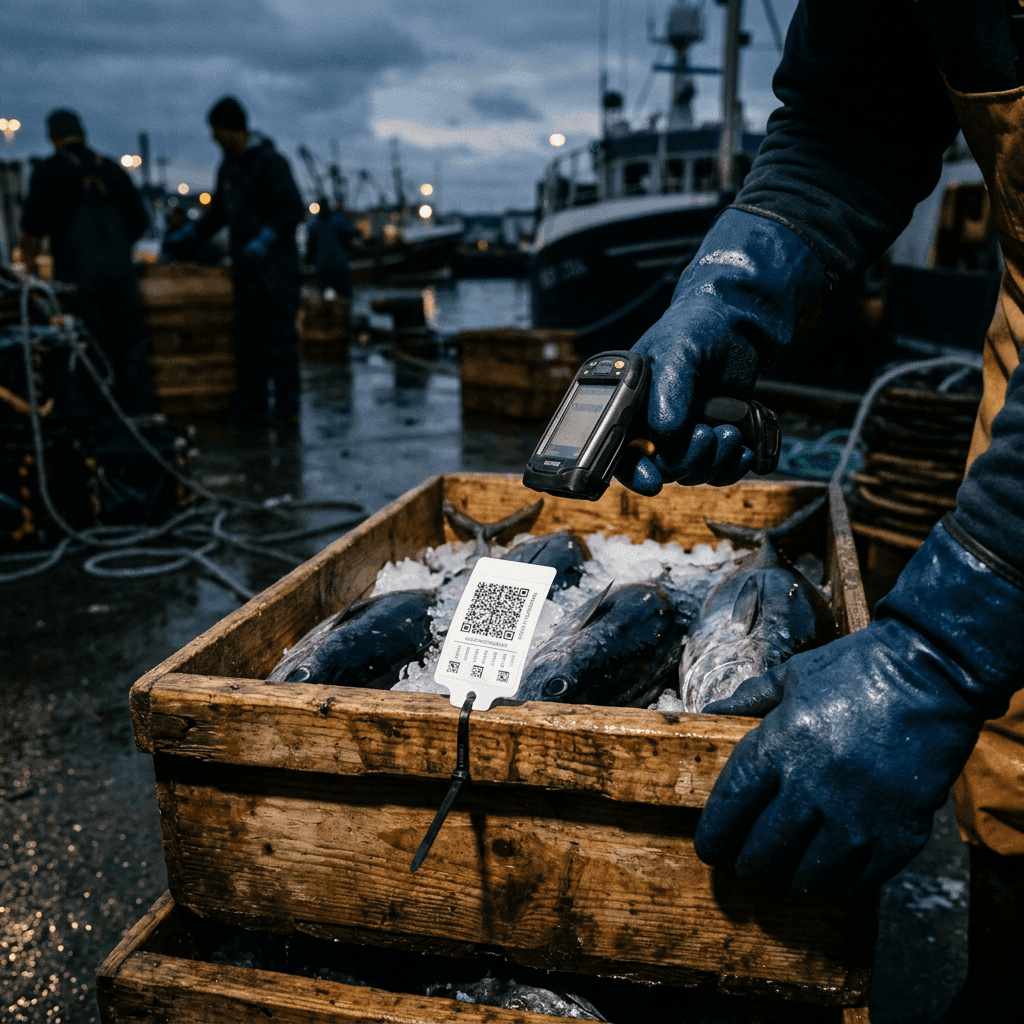
The answer is to make traceability a property of the supply chain rather than an afterthought bolted on at export. Bait-to-plate traceability and enforcement analytics, built on the fisheries intelligence platform, give fisheries ministries, coast guards and the businesses that supply them the evidence chain behind every landing. For an exporter, that is precisely the artefact a regulated buyer now demands: a documented provenance record that stands up to scrutiny rather than a claim that has to be taken on trust.
What makes the record credible is that it is not self-reported alone. The traceability analytics are fused from satellite and vessel data across the exclusive economic zone, and they are built explicitly to detect illegal, unreported and unregulated activity. That means the same system that proves a legitimate catch is legitimate is the one that flags the activity a clean supply chain needs to keep out. An exporter using it is not just documenting its own product; it is demonstrating that its sourcing is screened against the very behaviour importers are trying to exclude.
The platform's standing matters to buyers too. It is backed by the United Nations World Food Programme and the European Space Agency, which gives the provenance record a pedigree an importing authority recognises. For a retailer building a compliant sourcing programme, that recognition shortens the argument: the evidence comes from a platform with institutional backing, not from a spreadsheet the supplier maintains itself.
Sourcing that sees where the fish actually are
Provenance solves the compliance problem, but a seafood business also has to catch the fish profitably in the first place, and here the same underlying data earns its keep a second time. Satellite fish detection and fishing-zone advisories fuse earth and space data to guide fleets to productive waters, cutting wasted days at sea and improving the profitability of a catch. For an exporter whose margins are set by fuel burned and time spent searching, better-directed effort is money kept.
The advisories are delivered as a mobile application that crews download and use directly at sea, which matters for adoption. A traceability requirement that depends on fishermen filing paperwork tends to fail; a tool that first helps them find fish and, in doing so, captures the data that underpins provenance is one they actually use. The commercial incentive and the compliance record are aligned rather than in tension.
The same detection system also handles monitoring of unregulated and unsustainable fishing, so a business using it for sourcing is simultaneously building the picture that keeps its own supply base healthy. Over-fished waters are a threat to any seafood exporter's future, and detection data that supports sustainable effort is protection for the resource the whole business depends on. It is built by a specialist data-science team that pioneered analytics in fisheries, so the sourcing guidance rests on genuine domain expertise.
Compliance and commercial advantage, from one source
The two capabilities reinforce each other. Fish detection makes the catch more profitable and, in the same motion, captures the data that feeds traceability. Traceability turns that data into the provenance record a regulated market now demands. A seafood business that adopts both is not running a compliance cost centre alongside its commercial operation; it is running one system that improves the catch and proves it at the same time.
That integration is the point of a single accountable channel. Unstrat represents these capabilities as an independent, non-aligned route, one relationship from first briefing through delivery, drawn from a platform with United Nations and European Space Agency backing and free of any major-power strings. For an exporter or retailer, that means market access, sourcing efficiency and sustainability evidence come together rather than as three separate procurement problems.
Provenance has become a requirement precisely because trust in seafood supply chains has thinned. The businesses that will keep their market access are the ones that can replace trust with evidence, and turn the effort of producing that evidence into a commercial advantage rather than a cost.