
12 August 2026
What a ground station is
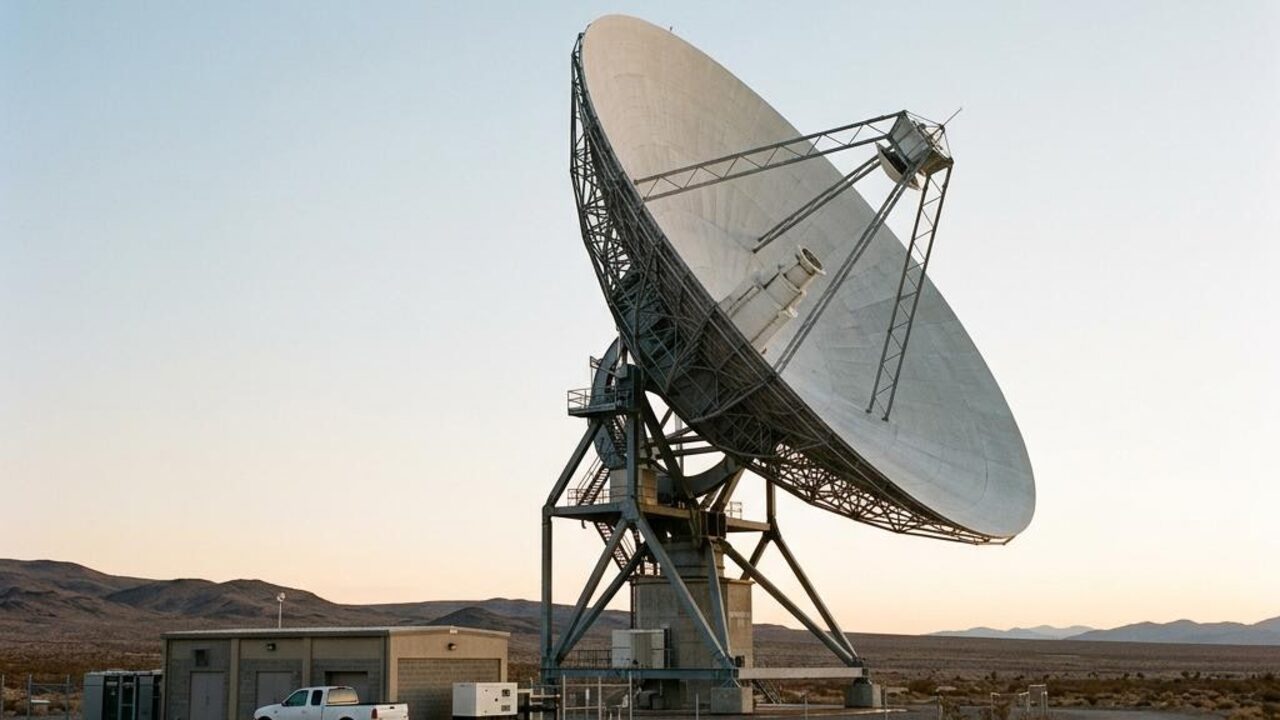
A satellite in orbit is deaf and mute until something on the ground talks to it. A ground station is that something: the facility that sends commands up to a spacecraft, receives its data and telemetry coming down, and keeps the link between the two working as the satellite crosses the sky. Every image, every message and every command that a space system produces or obeys passes through a ground station. The spacecraft is the part that gets photographed; the ground station is the part that makes it worth launching.
The anatomy, from the antenna inward
Trace the signal and the parts explain themselves. The antenna, usually a steerable dish, points at the satellite and tracks it across the pass, collecting a faint downlink and radiating the uplink. Behind it, the radio-frequency chain amplifies the weak received signal before noise swamps it and boosts the transmitted signal to reach orbit. The modem converts between radio waves and digital bits in both directions. Two functions then sit on top of that pipe: TT&C, telemetry, tracking and command, which keeps the spacecraft healthy and does what a spacecraft operator does (watch its vital signs, send instructions, correct its behaviour); and, for an observation or communications mission, the data handling that turns raw downlinked bits into a usable product. Mission control is the software layer that ties it together, planning what the satellite does on each pass and monitoring whether it did it.
TT&C versus payload, a distinction worth keeping straight
It helps to separate two jobs a ground station does, because they are often run by different teams and sometimes at different sites. Keeping the satellite alive and obedient (its orbit, its power, its temperature, its pointing) is TT&C, and it is unglamorous, safety-critical and continuous. Getting the mission product down (the imagery, the signals intelligence, the communications traffic) is the payload data job, and it is the reason the satellite exists. A station can do both or specialise in one. Understanding which a given facility does is the difference between commanding a spacecraft and merely receiving from it.
Why building one is the harder half
The anatomy is the easy half to describe and the smaller half of the effort. Building a ground station is a siting, engineering and operations programme. Where the antenna sits governs which orbits it can see and for how long each pass lasts, so location is a capability decision, not a real-estate one. The facility needs resilient power and connectivity, physical security, and protection for the electronics against weather and interference. It needs a link budget that closes reliably in the local conditions rather than on paper. And it needs people: operators who plan and run passes, and engineers who keep the antenna, the RF chain and the software working. A station bought as equipment and staffed as an afterthought produces downlinks; a station built as a programme produces a capability.
The half that decides control
For a national buyer, one more point outranks the engineering. Whoever runs the ground station decides what the satellite looks at, holds the data it produces, and can keep operating through a period of tension without asking anyone's permission. A state that launches a spacecraft but relies on a foreign facility to command it and download its imagery owns hardware in orbit, not a capability it controls. That is why the ground segment, and the training that lets nationals run it, is where the real decisions about a space programme are made. The anatomy tells you what a ground station is. The ownership question tells you whether it is yours.
What this means for a space-programme buyer
The anatomy of a ground station is straightforward, the antenna, the RF chain, the modem, TT&C and mission control, but understanding the parts is the smaller half of the task. Building one is a siting, engineering and operations programme, where location determines which orbits you can see, the link has to close in real conditions rather than on paper, and trained operators and engineers decide whether the facility produces a capability or just downlinks. The point that outranks all of this for a national buyer is control: whoever runs the ground station decides what the satellite looks at and holds the data it produces, which is why a spacecraft commanded from a foreign facility is hardware in orbit rather than a capability you own. Building the ground segment on national soil, sourced through one accountable channel with localisation and operator training scoped per programme, subject to export controls and end-use approvals, is how a state keeps its space capability in its own hands.
