
A bolt on the runway costs an engine. A drone closes the airport.
Airport continuity built around the two threats that stop aircraft, debris on the runway and drones in the approach, with quiet detection and a response plan for when it happens.

An airport is a system that fails at its edges
An airport runs on continuity. Every delay ripples outward through schedules, connections and contracts, and the two disruptions that stop aircraft fastest both happen at the edges of the airfield: on the surface of the runway and in the air above the approach.
The first is mundane and ruinous. A single piece of foreign-object debris (a bolt, a fragment, a strip of metal) ingested by an engine can destroy it and end a sortie. The second is newer and stops everything at once: an unmanned aircraft over the approach closes the airport until it is gone, whether or not anyone meant harm.
Both are continuity problems before they are security problems, and both reward the operator who has planned for them in advance. The capabilities that address them exist, and they can be assembled through one accountable channel rather than stitched together from separate vendors.
Clear the surface before it clears an engine
Foreign-object debris is a discipline of relentless, unglamorous sweeping, and it is exactly the kind of task that suffers when it depends on tired people walking a vast surface between movements. Automating it removes the human variability from a job where a single miss is expensive.
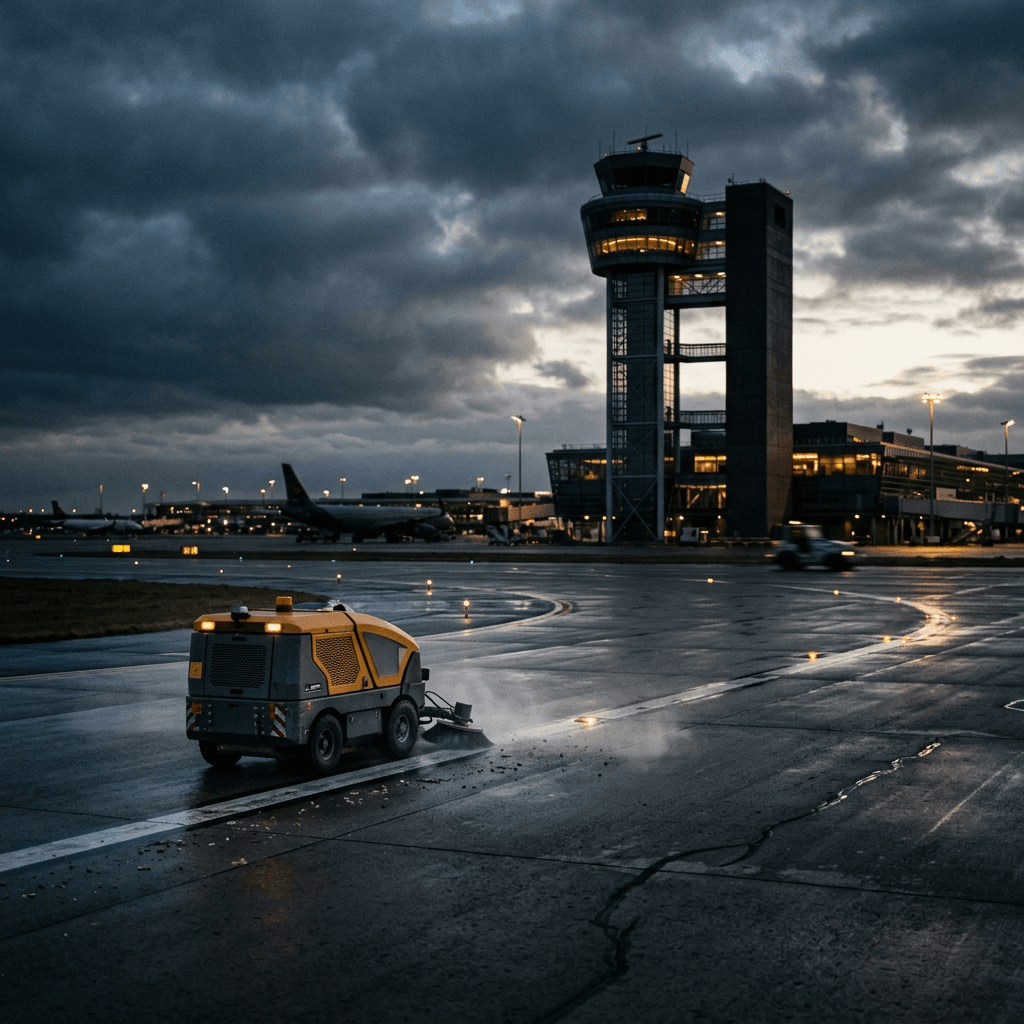
An autonomous foreign-object-debris clearance robot sweeps the deck clear of the debris that destroys engines and ends sorties, using autonomous navigation with obstacle avoidance to secure the surface one sweep at a time. It does the repetitive, high-consequence work consistently, at whatever cadence the operation requires.
Because it is built by a maker of unmanned ground and air systems, the clearance robot is designed for in-region sustainment rather than dependence on a distant OEM. For an airport operator, that means the capability keeps running long after the initial deployment, on terms the operator controls. Spares, support and the people who service it are arranged near the airfield, not on the far side of a procurement queue.
See the drone without lighting yourself up
The drone threat to airports is not only the deliberate incursion. It is the careless hobbyist, the lost commercial aircraft, the swarm of small, slow, low-flying objects that traditional radar struggles to see and that no one filed a flight plan for. Detecting them reliably is the first and hardest part of the problem.
Passive radar answers it without adding to the electromagnetic clutter of an already busy airfield. It emits nothing, exploiting illuminators already in the environment (LEO satellite downlinks, broadcast television and cellular signals) to give persistent, wide-area coverage over hundreds of square kilometres from a single receiver site, with no spectrum licence required. It is well suited to restricted zones and critical-asset protection precisely because it counters the small drones and slow-movers that defeat conventional radar.
When detection has to become defeat, layered counter-UAS provides it: radar, RF sensors and optical trackers with AI friend-or-foe classification, cueing interceptors priced for the mass threat rather than a missile economy. The two work together: quiet detection to find the threat, a layered response to remove it. Detection alone tells you the airport is closed; the layered defeat layer is what reopens it.
The economics matter here as much as at any base or border. A drone incursion is cheap to mount and expensive to suffer, and a defence that answers every small target with a missile-priced interceptor loses that exchange. A layered counter-UAS response is designed for the opposite arithmetic, affordable defeat at the scale the threat actually arrives in, so an airport is not bankrupting itself to keep a runway open.
The plan matters more than the panic
Airports are increasingly software-defined operations, and the disruption that closes a terminal is not always a physical object in the sky. It can be a compromise of the systems that run the airfield. When that happens, the difference between a bad hour and a bad month is whether there was a plan.
Incident response provides that plan and the team to execute it: containment, eradication and recovery when a live incident hits, with retainer and rapid-deployment options so the responders are arranged before the emergency, not during it. The engagement shortens the time an intruder has to spread, and leaves the estate more defensible afterwards because the findings feed back into hardening.
For an operator whose core promise is that aircraft move on time, that pre-arranged capability is continuity insurance. It turns the worst day into a rehearsed procedure rather than an improvised scramble.
Continuity, assembled and accountable
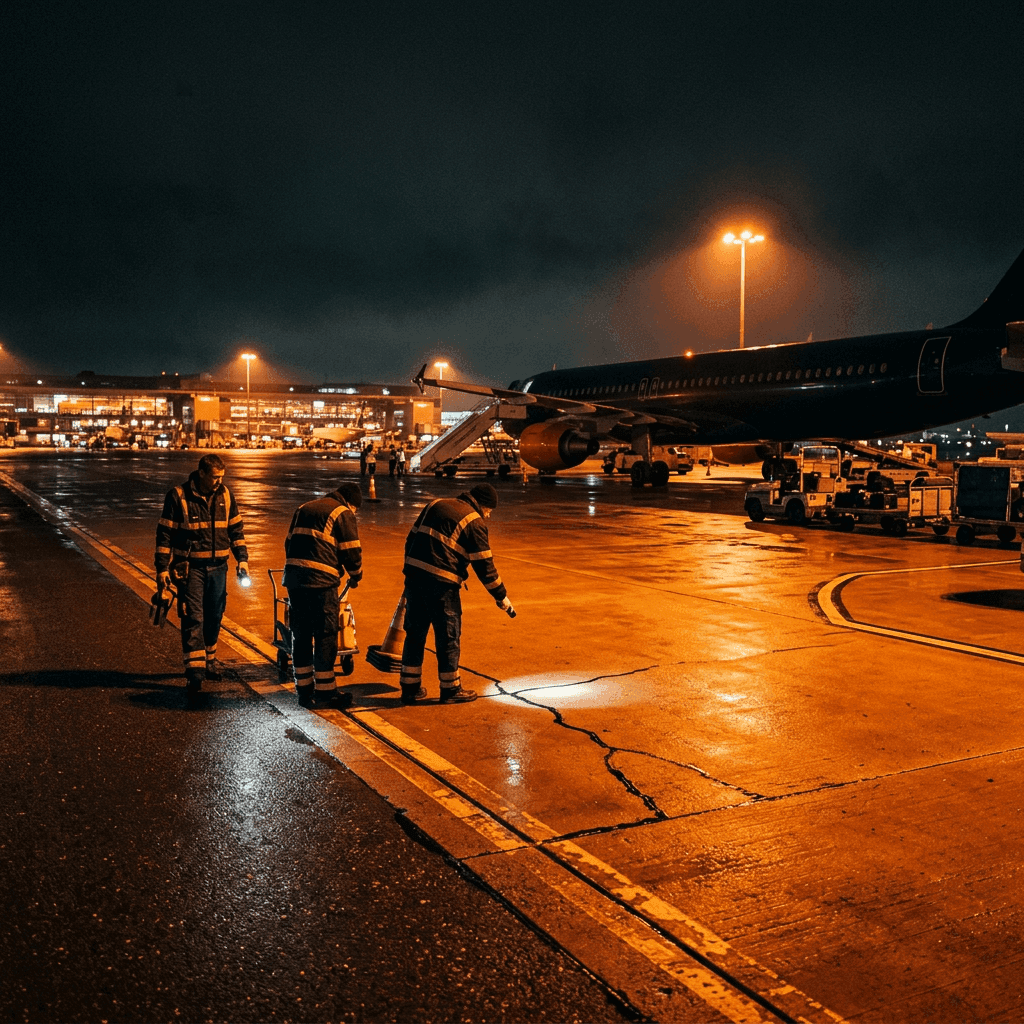
The threats to an airport come from different directions (the surface, the sky and the systems) and they are usually addressed by different suppliers who never talk to one another. Bringing them together under one accountable channel is where the value lies for an operator who has to keep runways open.
Autonomous debris clearance, emitter-free detection, a layered counter-drone response and a rehearsed incident-response capability are complementary parts of a single continuity posture. Unstrat is an independent, non-aligned vendor, so that posture is assembled and sustained on the operator's terms, with one team accountable for the outcome.
A bolt on the runway costs an engine. A drone closes the airport. The operators who treat both as continuity problems, and plan for them in advance, are the ones still moving aircraft when others are grounded.


