
Washington held back one bomb shipment. The rest of the arms flow continued.
Defence Secretary Lloyd Austin said the shipment contained high-payload munitions and was paused because a possible Israeli operation in Rafah could put civilians at risk. The administration said its wider commitment to Israel’s defence remained in place.
Washington did not stop arming Israel. It stopped one shipment and left the next decision open.
On 8 May 2024, Defence Secretary Lloyd Austin said President Joe Biden had decided to hold back a shipment of high-payload munitions to Israel. The concern was a possible Israeli offensive in Rafah, the southern Gaza city where Washington believed civilians could be put at risk. Austin also said the administration was reviewing some near-term security-assistance shipments.
The action was concrete, but its scope was narrow. Austin described one paused shipment, not a suspension of the US-Israel security relationship. The Reuters report said the United States was Israel’s biggest arms supplier and that Biden had continued sending weaponry worth billions after the Hamas attack of 7 October 2023. Austin stressed that the US commitment to Israel’s defence remained “ironclad”.
The same account made clear that the pause was not final. Austin told a Senate hearing that the administration had not made a final determination on how to proceed with the shipment. That qualification matters. A shipment can be held for review without being cancelled, and a warning about future consignments is not evidence that those consignments were later withheld.
The weapons were later described more precisely in a Pentagon briefing and congressional material. The shipment comprised 1,800 2,000-pound bombs and 1,700 500-pound bombs. Those figures are the number of weapons in the paused consignment, not a measure of all US weapons supplied to Israel and not proof that every bomb of those types was unavailable to the Israeli military.
The stated trigger was anticipated use, not a finding that the shipment had already been used unlawfully. Austin said the United States did not want a major combat operation in Rafah without protection for civilians. He said the administration had paused the shipment “as we have assessed the situation”. The language described a forward-looking risk judgment.
That also explains why the headline should not become a claim about battlefield effect. The available sources do not establish the shipment’s value, its position in the logistics chain, the stock already held by Israel, or whether other suppliers could substitute for the withheld weapons. They do not show that an Israeli sortie, target or operation was cancelled because of the pause.
The decision still mattered because it placed end-use conditions inside an otherwise close security relationship. A supplier can continue general assistance while scrutinising a particular consignment. The customer may possess the aircraft and retain other stocks, yet still face a decision point controlled by the supplying government. In this instance, the decision point was linked to how the weapons might be used in a named operation.
The administration’s two messages were therefore not contradictory. It could say that defence support remained firm and that one high-payload shipment was paused. The first described the relationship. The second described a consignment and a risk assessment. Treating either statement as if it cancelled the other would flatten the event into a false total.
The Rafah context was also not a final legal judgment. The report described Washington’s concern that an offensive could put civilians at risk. It did not report a court finding about the shipment, and it did not establish that Israel had committed a particular violation with these weapons. Nor did the pause itself determine whether a future operation would occur.
The later congressional record confirms the specific figures and the date of the administration’s confirmation. A Congressional Research Service summary also reported that the 500-pound bombs were later released while the 2,000-pound shipment was still reportedly under review as of October 2024. That is a later development, not a fact known at the 8 May announcement, and it should not be used to rewrite what Austin said that day.
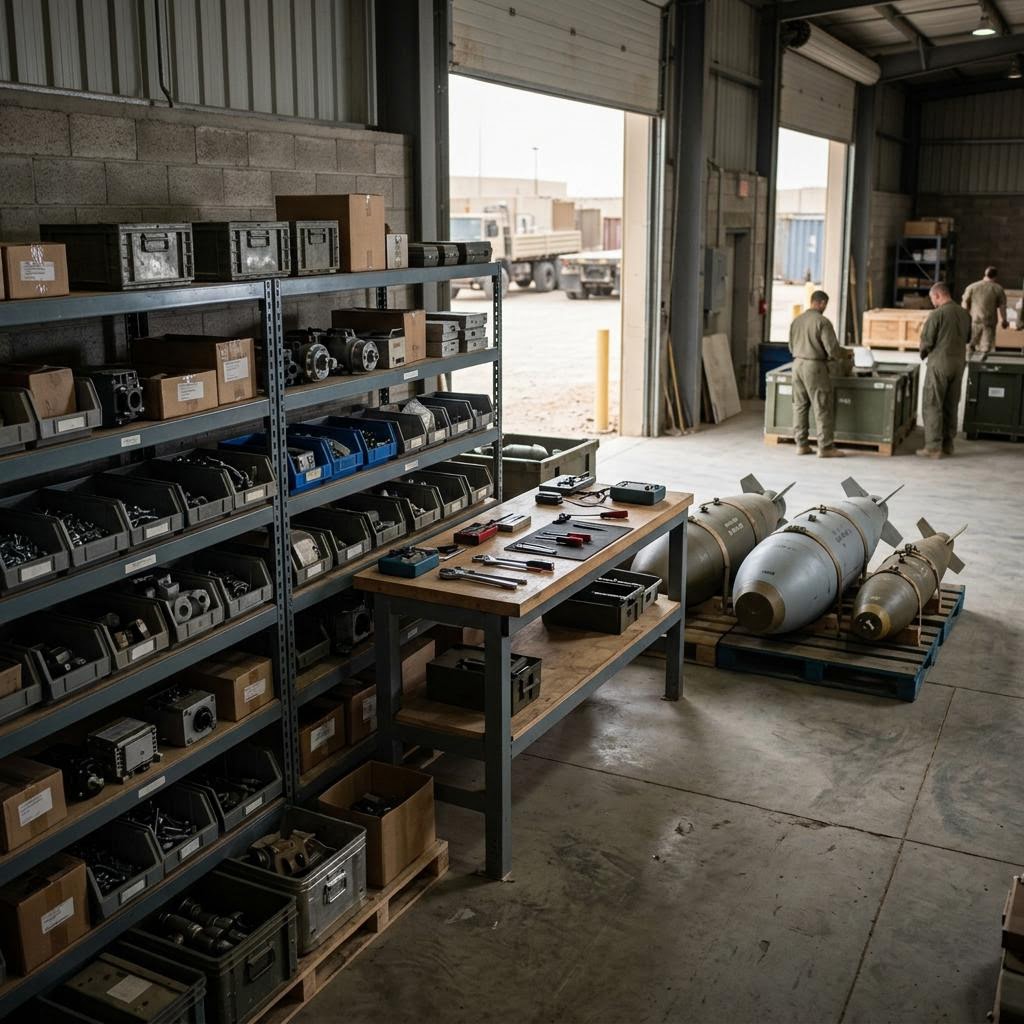
AI-generated representative image.