
12 May 2026 (Updated 12 August 2026)
The problem counter-UAS solves
Small unmanned aircraft have given inexpensive, deniable reach to anyone who wants it, from careless hobbyists to organised attackers. Counter-UAS (C-UAS) is the discipline of defending airspace against them: detecting that a drone is present, tracking and classifying it, and defeating it when it poses a threat. Each step is harder than it sounds against targets that are small, slow, low and often plastic.
Detect and track: the sensor layer
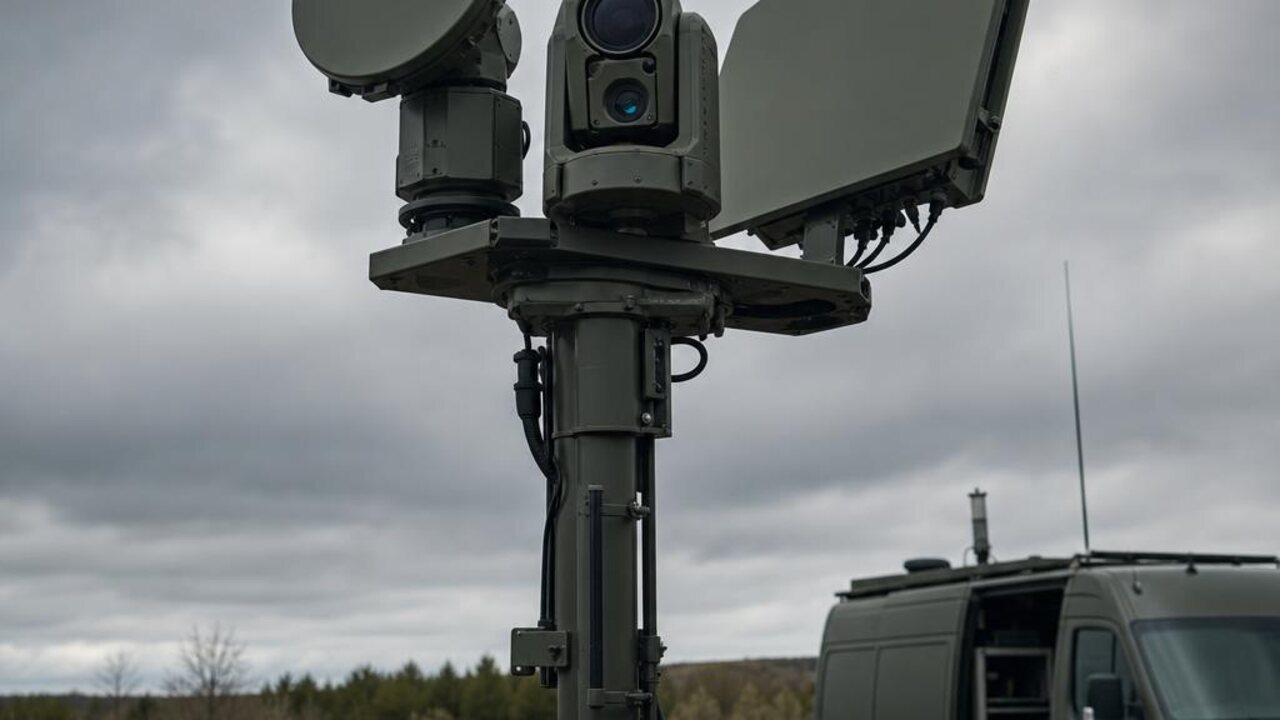
No single sensor sees every drone. Radar provides range and persistent coverage but struggles with small, low, slow targets among clutter. Radio-frequency sensors detect the link between drone and operator (and locate the operator) but miss autonomous aircraft flying without emitting. Electro-optical and infrared cameras confirm and identify what other sensors cue. Acoustic and passive sensors add coverage where emissions are undesirable. Serious systems fuse several.
Defeat: the effector layer
Defeat options split into non-kinetic and kinetic. Jamming breaks the drone's control or navigation links; spoofing misleads them, both effective against remotely piloted aircraft, less so against autonomous ones. Kinetic options, from net capture to interceptor drones to gun and missile systems, physically stop the aircraft, with the choice governed by collateral risk, environment and the scale of the threat.
It is a system, not a gadget
Effective C-UAS is command-and-control tying sensors and effectors into one picture with clear engagement authority, layered so that what one element misses, another catches. Buyers should evaluate offerings as systems: coverage against the local threat spectrum, integration openness, operator workload, legal fit for the deployment environment, and sustainment. A brilliant single sensor inside a poor architecture protects nothing.
Layered defence, because depth buys decision time
The word layered is used loosely, so it is worth being precise about what it buys. A single defensive ring gives one chance to detect, decide and act, and against a fast or low target that chance can be a few seconds. Concentric layers change the arithmetic: a wide-area sensor picks up a track well beyond the perimeter, an inner sensor classifies it, and a soft-defeat option is attempted before a hard one becomes necessary. Each layer's job is partly to hand the next one time. Depth is not redundancy for its own sake; it is the difference between an operator who has room to make a proportionate decision and one who is forced into a reflex at the fence line.
Detection and defeat pull in different directions
Buyers tend to shop for detection and defeat separately, but the interesting trade-offs sit between them. A sensor tuned to miss nothing floods the operator with false alarms and, by day three, gets ignored; a sensor tuned for a quiet console misses the small, slow, low target that mattered. On the defeat side, the cleanest options legally and physically, jamming and capture, are the ones most easily defeated by an autonomous or fast threat, while the options that always work, kinetic ones, are the hardest to use safely over people and infrastructure. A serious evaluation looks at how the system resolves these tensions together: whether classification is good enough to justify a graduated response, and whether the defeat layer matches what detection can actually confirm in time to act.
The cost-exchange logic that decides who tires first
There is an economic layer beneath the technical one. If a defender spends a premium interceptor to stop a drone that cost an attacker very little, the defender wins the engagement and loses the campaign, because the attacker can send more drones than the defender can afford to counter. Against threats that arrive in volume, cost per engagement becomes part of the system's performance, not a procurement footnote. That points toward defeat layers cheap enough to use repeatedly (jamming where it works, capture and low-cost interceptors) with the expensive options reserved for the threats that genuinely require them. A counter-UAS system that only defends by expending more value than it destroys is an architecture designed to be outlasted.
What this means for buyers
The advantage does not sit in any single sensor or effector. It sits in the architecture that ties them together. A buyer who evaluates a counter-UAS offering as one integrated system, judged against the threats that actually approach the site rather than a demonstration drone on a calm day, ends up with airspace that is genuinely protected rather than a collection of impressive parts. That means weighing sensor fusion, defeat layering, operator workload and the legal fit of the deployment environment as one whole, and demanding integration openness so the system can absorb new sensors and effectors as the threat evolves. Sustainment matters as much as capability: the mission is defended for years, not for a trial. Treat the system, its command-and-control and its supplier relationship as inseparable, and the protection holds.
