
28 April 2026
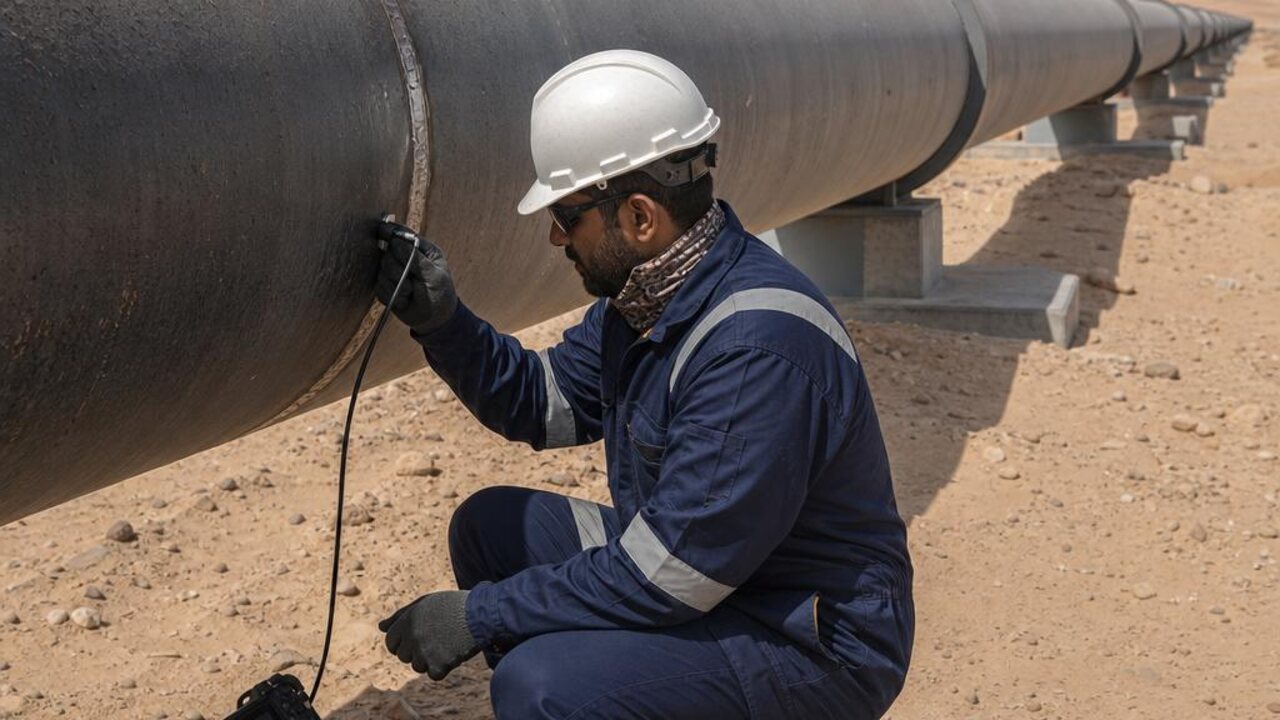
Pipelines as strategic infrastructure
In Gulf energy economies, pipelines are not merely industrial assets. They are the arteries of national revenue and, increasingly, recognised targets. A weld failure and a deliberate attack have different causes but similar consequences. Integrity management, with non-destructive inspection at its core, is therefore as much a resilience programme as a maintenance one.
The inspection toolkit
Pipeline integrity leans on two NDT families. Radiography, increasingly digital rather than film, verifies girth welds during construction and repair. Ultrasonics carry the in-service burden: wall-thickness surveys, corrosion mapping and flaw detection at excavations, terminals and crossings, complementing the in-line inspection tools that run inside the line itself.
The Gulf's specific conditions
The region adds its own demands: extreme surface temperatures that constrain field work and instrument tolerance, corrosive coastal and sabkha environments, long remote desert sections where inspection crews operate far from support, and the density of critical crossings around terminals and industrial cities where inspection standards are at their most exacting.
Building the capability, not just buying instruments
Operators get durable value when they procure inspection as a capability: certified equipment matched to their pipe classes and standards, operator training and certification schemes, calibration infrastructure, and a supplier relationship that sustains all of it in-region. Instruments without that system produce readings; the system produces integrity.
Why this matters for Gulf operators
For operators whose pipelines carry national revenue, inspection is a way to protect strategic infrastructure, not just a maintenance chore. The lasting advantage lies in procuring integrity as a capability that tolerates the region's heat, corrosion and remoteness: certified equipment matched to your pipe classes and standards, trained crews, calibration infrastructure and a channel that sustains all of it close to the asset. A shipment of instruments produces readings; a sustained system produces the assurance the mission depends on. Favour a single accountable relationship over fragmented supply, and where in-region training, calibration and service are involved, scope localisation arrangements per programme, subject to export controls and end-use approvals. That is how inspection becomes resilience rather than paperwork.
