
The airspace over an event is part of the venue.
Protecting leaders and national events now means defending the sky above them, with detection that moves with the detail, interceptors that respond in seconds and sensing that never gives itself away.

The threat now comes from above
A national event used to be secured on the ground: cordons, sweeps, access control, close protection. The perimeter was a line you could walk. That line no longer holds, because the most serious threat to a leader or a crowd increasingly arrives from directly overhead, launched from beyond any fence you can build.
A cheap drone carrying a payload does not care about your cordon. It flies over it. Which means the airspace above a venue is no longer someone else's responsibility. It is part of the venue, and it has to be protected like the rest of it. The uncomfortable truth is that most protective details are equipped for the ground threat and blind to the air one.
Closing that gap does not require turning a public square into a missile site. It requires the right sensing where the detail actually stands, a defeat layer that responds in seconds, and awareness that does not announce itself to the very people it is meant to catch.
Detection that moves with the detail
Fixed-site sensors protect fixed sites. A leader moves, an event changes venue, a motorcade takes a new route, and the coverage a permanent installation provides simply is not there. That is the coverage gap that leaves protection details exposed the moment they step beyond a prepared perimeter.
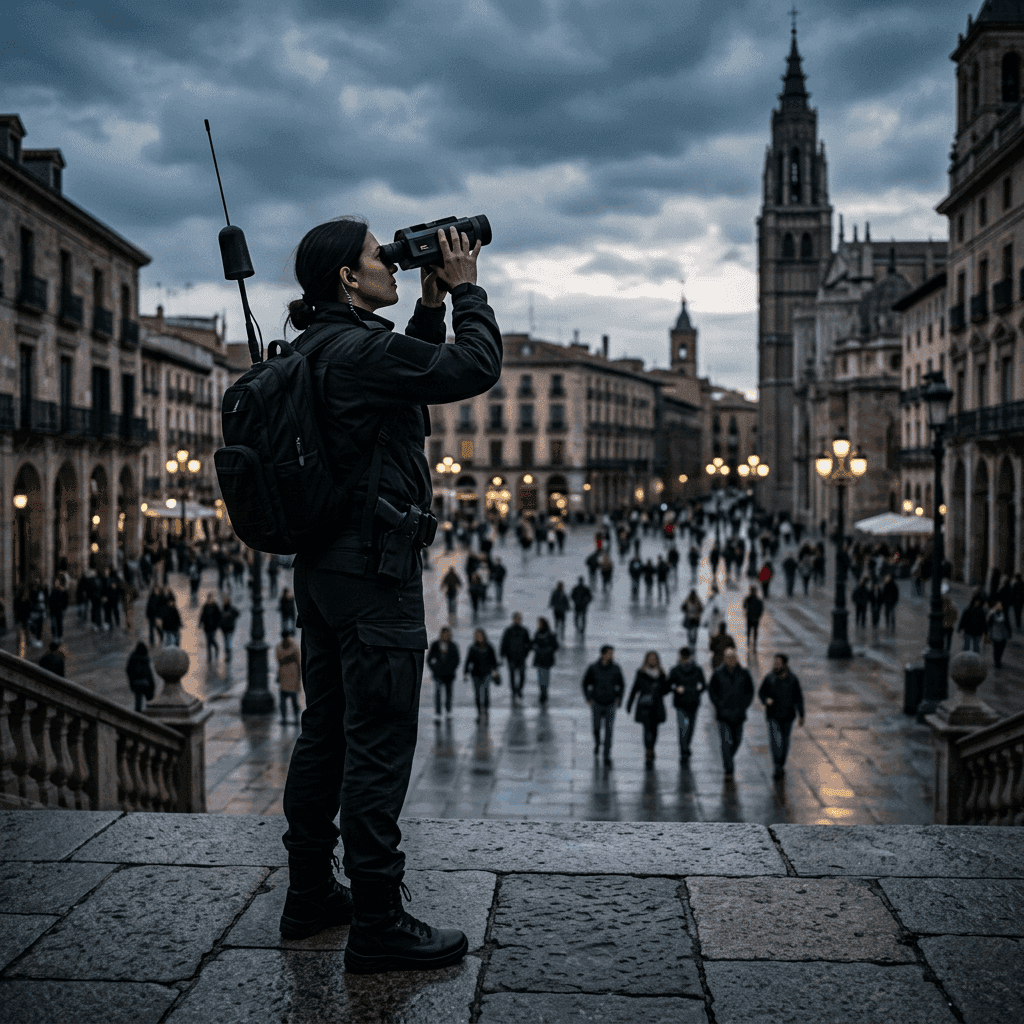
Our dismounted drone-detection manpack is built to close it. It is portable drone detection carried by the team itself: lightweight, battery-powered, soldier-operable and quick into action, giving a protection detail early warning at the individual-team level. It delivers the seconds a crew needs to react to an approaching drone, and those seconds are the whole engagement.
When the detail is within range of the wider layered counter-drone architecture, the manpack integrates with it, so dismounted awareness feeds the same fused picture as everything else and is discriminated against friendly traffic rather than adding to the confusion. The detection travels with the people it protects rather than staying behind at a site they have already left, and it never becomes an orphaned system that only its own operator can read.
A response measured in seconds
Detection buys time only if there is something to spend it on. Over an event, the response has to be precise, fast and mindful of the crowd below. The AI-assisted interceptor is built for exactly that: AI-enabled detection and tracking for a rapid lock, high-speed interception to close the distance, and operator-assisted precision engagement so a person keeps mission control of the defeat decision. It is designed to neutralise a hostile drone with minimal collateral risk, day or night, and it holds up in RF- and GPS-denied conditions.
For the close-in, confined fight (inside a venue, between buildings, where a larger platform would never manoeuvre), the hand-deployable kinetic interceptor gives the team a fast, guided response they carry and throw into action. It integrates with existing command-and-control and ground sensors, so it slots into the protective plan rather than standing apart from it.
Both interceptors keep the operator in the loop and carry smart recovery behaviour, which matters more over a crowd than anywhere else. The point is a proportionate defeat layer that a protection team can actually employ in a populated setting, not a blunt instrument that trades one danger for another.
Sensing that never gives itself away
There is a second reason a venue's airspace defence must be handled carefully: an active radar advertises itself. It tells a competent adversary exactly where the defence is, and in a protective context that is intelligence you would rather not hand over. Emissions are a liability when the whole point is to watch quietly.
Our emitter-free passive radar answers that by detecting and tracking with zero transmit power. It exploits illuminators already in the environment (LEO satellite downlinks, broadcast television, cellular base stations), so there is nothing for an adversary to home on, and it needs no spectrum licence to operate. From a single receiver site it holds persistent coverage over hundreds of square kilometres, and it is specifically suited to the small drones and slow-movers that defeat traditional radar.
That combination of wide, persistent, silent coverage of the approaches with a quiet screen against the very targets that matter here makes emitter-free sensing the natural backbone for protecting a leader or a national event without turning the defence itself into a beacon.

Protecting the whole venue
Protective security has always been about covering the space a principal occupies. That space now includes the sky, and the tools to cover it exist: detection that moves with the detail, interceptors that respond in seconds and proportion, and sensing that never announces itself. Assembled together, they extend the perimeter upward without changing what a protective operation feels like on the ground.
Delivered through one accountable, non-aligned channel, the whole package answers to the authority running the event rather than to a foreign supplier's conditions. The airspace over an event is part of the venue. It should be secured like the rest of it.


