
Cyprus sold its Mi-35s. Russian support had become the liability.
Cyprus and Serbia agreed the purchase of ageing Russian Mi-35s in 2021, and Serbia had acquired all 11 surviving aircraft by November 2023. Specialist reporting says sanctions disrupted Russian maintenance and that Cyprus pursued replacement attack helicopters.
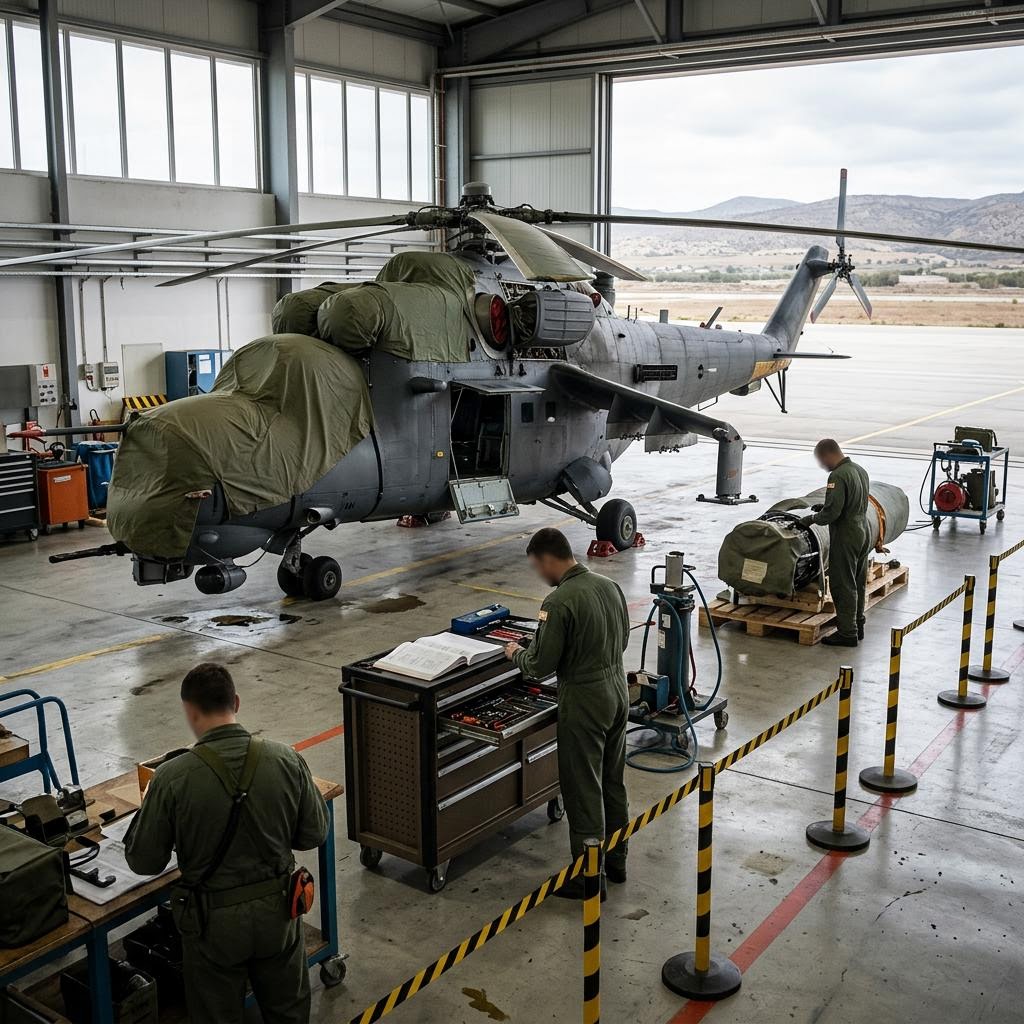
Cyprus did not wait for its Russian gunships to become worthless. It sold the surviving fleet while the support problem was becoming harder to manage.
Reuters reported on 23 November 2023 that Serbia had acquired 11 Russian-made Mi-35 helicopter gunships from Cyprus. The Cypriot government and Serbia had agreed the purchase in 2021. Reuters said the price was unspecified and that part of Serbia’s payment was made through Serbian-made weapons. The helicopters were ageing and required an overhaul.
The sale was the visible decision. The reason for it needs a more careful account than a simple claim that sanctions forced Cyprus out of Russian equipment. Key Aero reported that the availability of Cyprus’s Mi-35P fleet declined after sanctions were imposed on Russia. It said Cyprus could not pay Russian Helicopters for continuing maintenance and spare-parts support and was forced to ground its remaining gunships. The same report said Cyprus ordered six H145M light attack helicopters from Airbus as a replacement.
These sources describe different moments and different levels of certainty. Reuters reported the completed acquisition and the overhaul requirement in November 2023. Key Aero’s June 2023 account described the maintenance and replacement pressure before the transfer. A November Key Aero report said the 11 surviving aircraft were moved from Paphos to Serbia in three Antonov An-124 flights between 19 and 21 November. The transport detail confirms delivery, not the condition of every airframe.
Cyprus originally received 12 new-build Mi-35Ps in 2001, according to Key Aero. One was lost in a fatal crash in 2006, leaving 11 survivors. The helicopters had previously undergone major overhauls at the 419th Aircraft Repair Plant near St Petersburg. That history matters because the fleet’s support relationship was not an incidental after-sales service. The aircraft had already depended on Russian overhaul infrastructure.
By 2023, that relationship had become politically and financially exposed. Key Aero said Cyprus’s Ministry of Defence could not pay Russian Helicopters for continued maintenance and spare parts because of sanctions on Russia. Reuters did not independently describe the sanctions mechanism, but its report records the resulting transaction: Cyprus agreed to sell the ageing aircraft to Serbia, where they would require overhaul.
The replacement decision was not a declaration that the Mi-35 was militarily useless. The type remained valuable enough for Serbia to acquire and plan to modernise. Reuters said Serbia wanted the aircraft to bolster its air force and maintain regional military supremacy. That is the Serbian president’s stated purpose, not an independent assessment of the helicopters’ future performance.
The timing also matters. Cyprus’s sale agreement with Serbia dates to 2021, according to Reuters. The maintenance pressure described by Key Aero was reported in 2023. The sources do not prove that sanctions alone caused the agreement, that the sale was initiated only after a specific failed payment, or that Cyprus could not have retained the aircraft through another support route. The reported sequence identifies a support risk. It does not establish a single cause for the sale.
There was also a transition cost. The Mi-35s were not simply exchanged for a ready replacement. Key Aero reported that Cyprus intended to replace them with six H145M light attack helicopters in two batches. Another report described a plan for 12 new attack helicopters over a longer period, but the available accounts do not establish the final procurement quantity or delivery schedule. The replacement programme therefore should not be presented as an immediate one-for-one restoration of capability.
Serbia’s later experience reinforces the same qualification. FlightGlobal reported in July 2024 that Serbia was flight-testing its first ex-Cypriot Mi-35 and working to return the 11 aircraft to flying condition. That outcome is consistent with Reuters’s statement that an overhaul was needed. It does not tell us how many were operational in Cyprus before the transfer or whether Cyprus suffered a measured readiness gap.
AI-generated representative image.