
12 August 2026
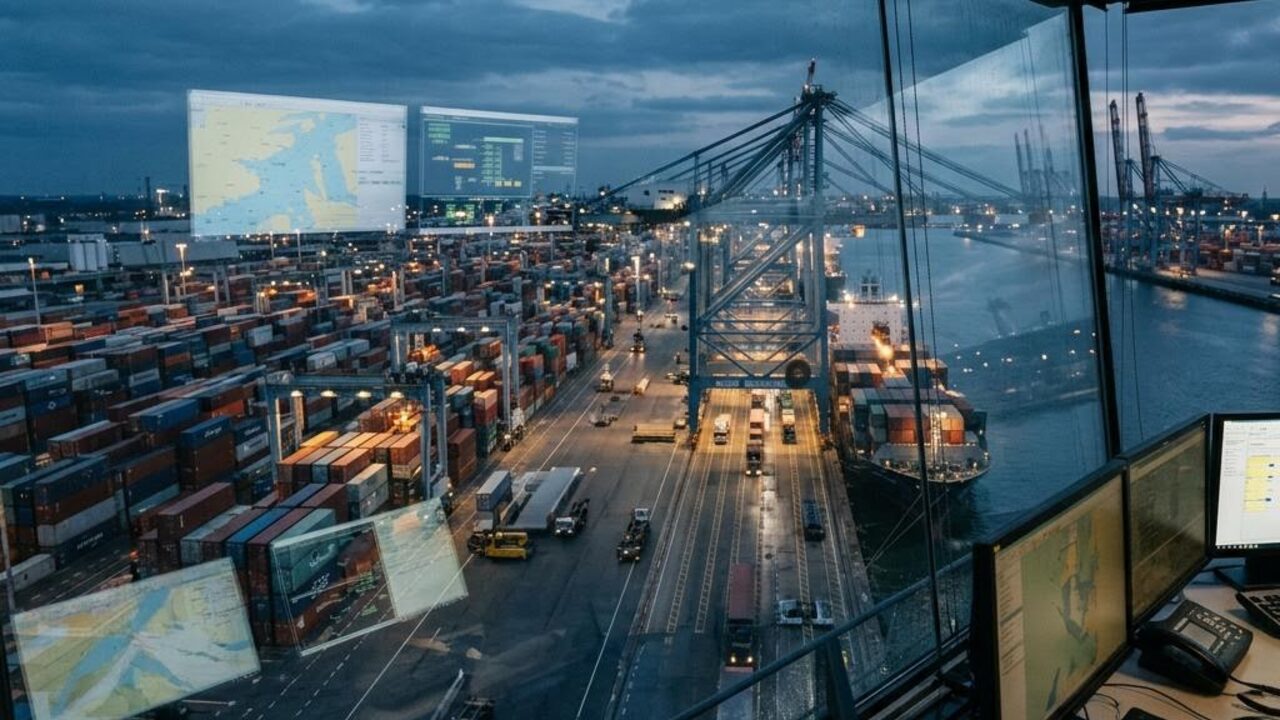
Why a port is worth attacking
A container terminal is a national choke point disguised as a logistics site. Interrupt the cranes, the terminal operating system that assigns every box a place, or the gates that let trucks in and out, and the effect propagates through supply chains within a day and through a national economy within a week. That is what makes ports attractive to both criminal extortion and state pressure: an adversary does not need to sink anything or breach a perimeter fence. Stopping the flow of containers is leverage in itself, and it can be applied from a keyboard.
The port is an OT environment wearing an IT badge
Port security is often scoped as if the risk were the corporate network and the customs database. The consequential systems are operational: ship-to-shore and yard cranes, straddle carriers and increasingly automated equipment, the terminal operating system that choreographs it all, and the industrial control behind fuel, power and refrigerated-cargo services. These run on long-lived control technology from specialist vendors, integrated under commercial deadlines, and connected to shipping lines, customs, haulage firms and equipment makers. The interfaces that make a modern port efficient are the same interfaces an intruder uses to reach the machinery.
Defending across owners who do not report to you
The awkward truth of port cybersecurity is that no single authority controls the whole estate. The port authority, the terminal operators, the shipping lines, the haulage companies and the equipment vendors each own a piece, and an attacker only needs the weakest of them. Practical defence therefore starts with the unglamorous work: an inventory of the control systems and every party that touches them, segmentation between the terminal operating system and the crane and process control beneath it, brokered and audited remote access for the vendors who maintain automated equipment, and monitoring tuned to the predictable rhythm of a working quay, where an out-of-hours command to a crane stands out sharply.
Keeping the boxes moving under attack
Ports are judged on throughput, so the plan for degraded operation matters as much as the perimeter. Can the terminal fall back to manual or local crane control? Can boxes still be tracked and released when the terminal operating system is offline or suspect? Are backups of that system tested against a real restore rather than assumed? A terminal that has rehearsed running slowly by hand, rather than stopping entirely, denies an attacker the clean shutdown that makes extortion pay and keeps a national trade artery open while the intrusion is contained.
What this means for port and terminal operators
The thing worth defending at a port is the flow of containers, not the file server, because stopping that flow is leverage an adversary can apply without ever crossing the fence. The advantage goes to operators who treat the terminal as the OT environment it is: inventory the cranes, the terminal operating system and the industrial control beneath them, segment those layers, broker vendor remote access, and monitor against the steady rhythm of a working quay. Because a port is a patchwork of owners who do not report to one another, defence has to be coordinated across the authority, the terminals, the lines and the equipment makers, and it has to include a rehearsed way to keep moving boxes by hand when the operating system cannot be trusted. Sourced through one accountable channel, with localisation and in-region support scoped per programme, subject to export controls and end-use approvals, the terminal keeps trade moving when it counts.
