
Colombia owned 26 Russian helicopters. The repair money could not reach Russia.
Colombia received 26 Russian Mi-17 helicopters between 1996 and 2009. In 2024, Defense Express reported that a contractor could not receive payment under a repair arrangement because sanctions blocked its access to SWIFT, leaving only nine of about 20 aircraft in flight-capable condition according to the report.
Colombia’s Mi-17 problem was not ownership. It was the bill for keeping ownership useful.
Defense Express reported on 16 March 2024 that Colombia’s army was struggling to pay for repairs to its Russian-origin Mi-17 helicopters. The contractor named in the report, National Aviation Service Company SA, could not receive payments because Western sanctions on Russia had blocked its use of the SWIFT payment system and placed it on what the report called the “Clinton list”. Defense Express attributed those details to Infodefensa, citing DAVAA, the Colombian Army’s aviation branch.
The payment problem followed a service relationship built around Russian equipment. Defense Express said Colombia had received 26 Mi-17 helicopters in different variants from Russia between 1996 and 2009. The report said the army then had about 20 Mi-17s, of which nine were in flight-capable condition, nine were under conservation, and two were damaged and awaiting dismantling for spare parts. Those figures are the publication’s account. They are not an independently audited fleet inventory.
The distinction matters. “In flight-capable condition” is not the same as a formal readiness rate, and “under conservation” does not by itself prove that an aircraft was permanently unavailable. The article does establish a reported maintenance backlog and a payment channel that had become difficult to use. It does not prove that all 20 aircraft were grounded, that sanctions caused every non-operational status, or that Colombia had no other lawful repair route.
The report placed the problem in a wider decision by Colombia. During the winter of 2023, the United States offered several countries, including Colombia, compensation for Soviet- and Russian-made helicopters transferred to Ukraine. Colombia refused that offer, according to Defense Express. The refusal left the country with its existing Mi-17 fleet and its existing support problem. The two decisions are related in the report, but refusal of the transfer is not evidence that the later maintenance difficulty was deliberately accepted or foreseen.
The practical choke point was financial. A helicopter can sit in its owner’s hangar while the support contract fails somewhere else. If the contractor cannot receive payment, the owner may still possess the airframe but lack an ordinary route to overhaul work, spare parts or contracted technical support. That is a procurement dependency rather than a battlefield loss.
The report also says Colombia expected the rotorcraft still in service to last until 2026 or 2027. That is a planning horizon, not a guarantee of availability. It does not tell us whether the army found another payment method, whether a different contractor took over, or whether the expected service life changed after the article was published.
One explanation in the report requires special caution. Defense Express suggested that Russian defence-industry representatives might have used Colombian legal entities to preserve access to the market. The article explicitly described that as a hypothesis still awaiting confirmation or refutation. It must not be rewritten as an established fact about the contractor.
The reporting establishes a payment barrier linked to sanctions and describes the Mi-17 fleet as only partly flight-capable. It does not resolve the contractor’s legal and ownership links, the precise sanction designation or the availability of alternative support.
Nor does the source establish a measured operational effect. It does not say how many missions were cancelled, whether transport capacity fell, or whether a Colombian unit lost a defined capability. It gives no independent comparison with the fleet before sanctions, and no later account of a final repair contract. The nine-aircraft figure should therefore remain attributed to Defense Express rather than presented as a settled readiness statistic.
Colombia’s helicopters were not stopped by an export ban on the airframes. The reported barrier sat at the repair workshop and in the bank transfer. Whether Colombia found another route before the stated 2026-2027 horizon is not reported.
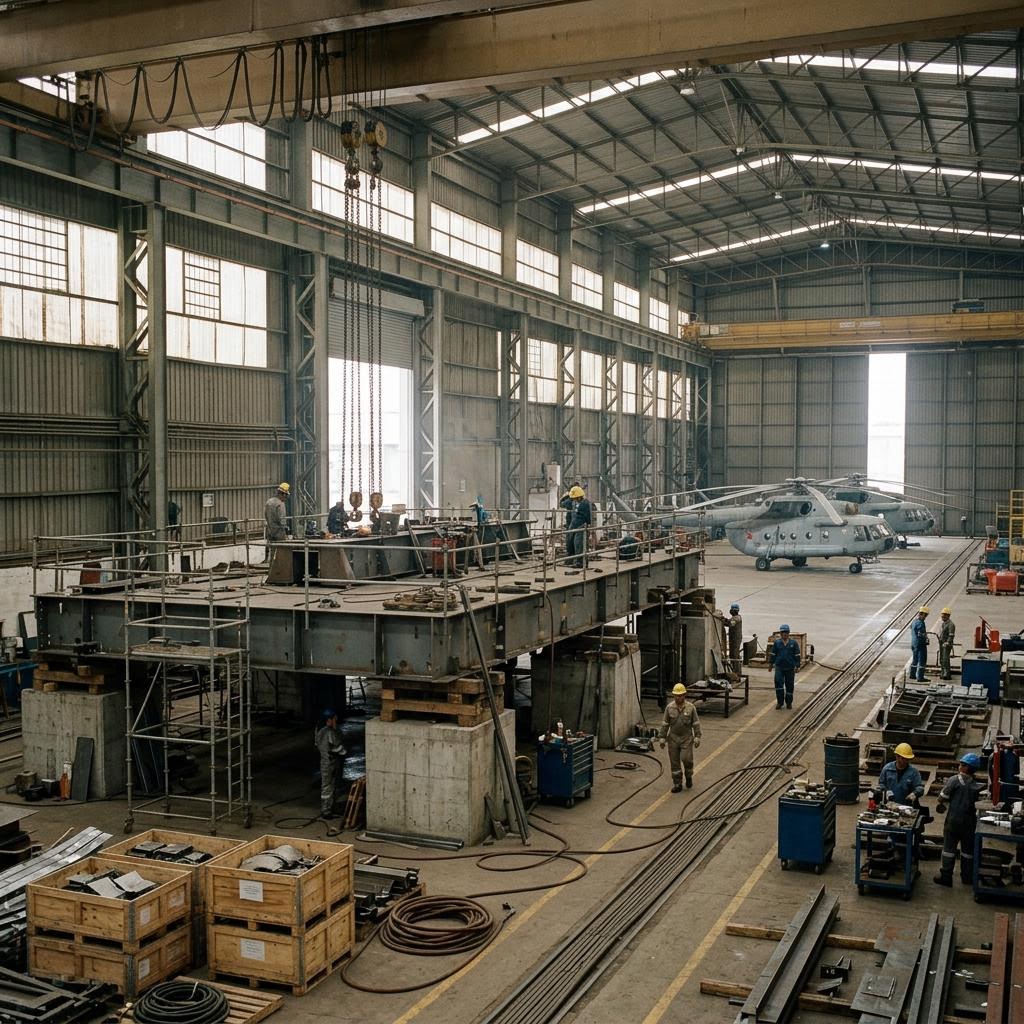
AI-generated representative image.