
Indonesia had 233 fighters. Its air force said half were grounded for lack of US spares.
In December 2001, Indonesian commanders said the US embargo had left only 40 to 50 percent of the fighter fleet operational.
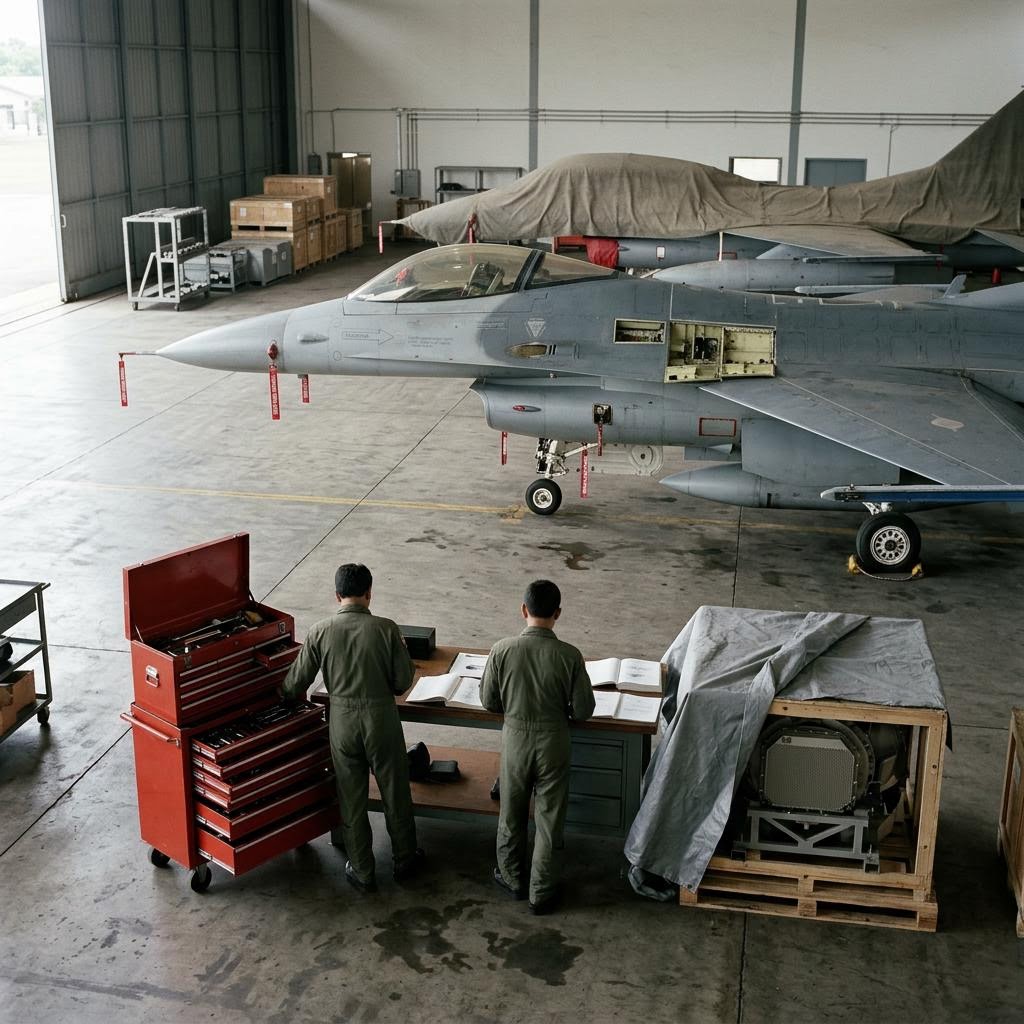
Aircraft can remain national assets and still become unavailable when the parts pipeline is controlled elsewhere. In December 2001, Indonesian military officials said a US embargo and the resulting shortage of spare parts had grounded about half of the country’s fighter aircraft.
The recovered East Timor Action Network archive preserves an Agence France-Presse report dated 4 December 2001. It quoted Air Force chief of staff Marshal Hanafie Asnan as saying that only 40 to 50 percent of Indonesia’s 233 fighters were operational. Armed forces spokesman Air Rear Marshal Graito Usodo confirmed the statement. The report said Indonesia’s US-made fighters included F-16s, F-5s, Skyhawks and OV-10s.
This is not the same as saying that half of Indonesia’s F-16s were grounded. The reported denominator was 233 fighter aircraft, and the named US-made types extended beyond the F-16. The case record links the mechanism to F-16 spares, but the recovered report describes a wider group of aircraft. The article therefore keeps the figure attached to the AFP report and does not convert it into an F-16-specific readiness rate.
The operational claim came from the Indonesian military, not from a fleet audit reproduced in the archive. The report said the aircraft were grounded for lack of spare parts because of the US military embargo. It did not list the parts, aircraft by type, maintenance backlog or length of time each aircraft had been unavailable. “Forty to 50 percent operational” was an official estimate reported by AFP, not a measured daily availability series.
The political context was the violence in East Timor after Indonesia’s August 1999 independence vote. AFP reported that Washington cancelled all military cooperation following the violence and that military-backed militias carried out murder and destruction. The report also quoted a US Pacific commander saying full bilateral cooperation could resume when Indonesian military reforms and accountability actions had matured.
The quoted Indonesian position was openly critical of the US implementation. Usodo said the United States had repeatedly said the embargo would be lifted but that implementation was not matching those assurances, particularly for fighter aircraft. Asnan said US officials had recently made noises about lifting the embargo but had not honoured that promise. Those are statements by Indonesian officials. They should not be presented as an independent finding about US policy.
The report also recorded a distinction within the embargo. Usodo said the United States had lifted the embargo on spare parts for transport aircraft in September 2000. That did not, on the report’s account, restore the fighter-parts pipeline. A partial relaxation for transport aircraft therefore cannot be described as a complete end to the military restriction.
AI-generated representative image.