
Turkey built an Altay tank. Germany’s engine and transmission did not come.
German export restrictions blocked Turkey’s intended MTU engine and RENK transmission for the Altay. In March 2021, BMC reached an agreement with South Korean companies for a replacement powerpack, but testing still lay ahead.
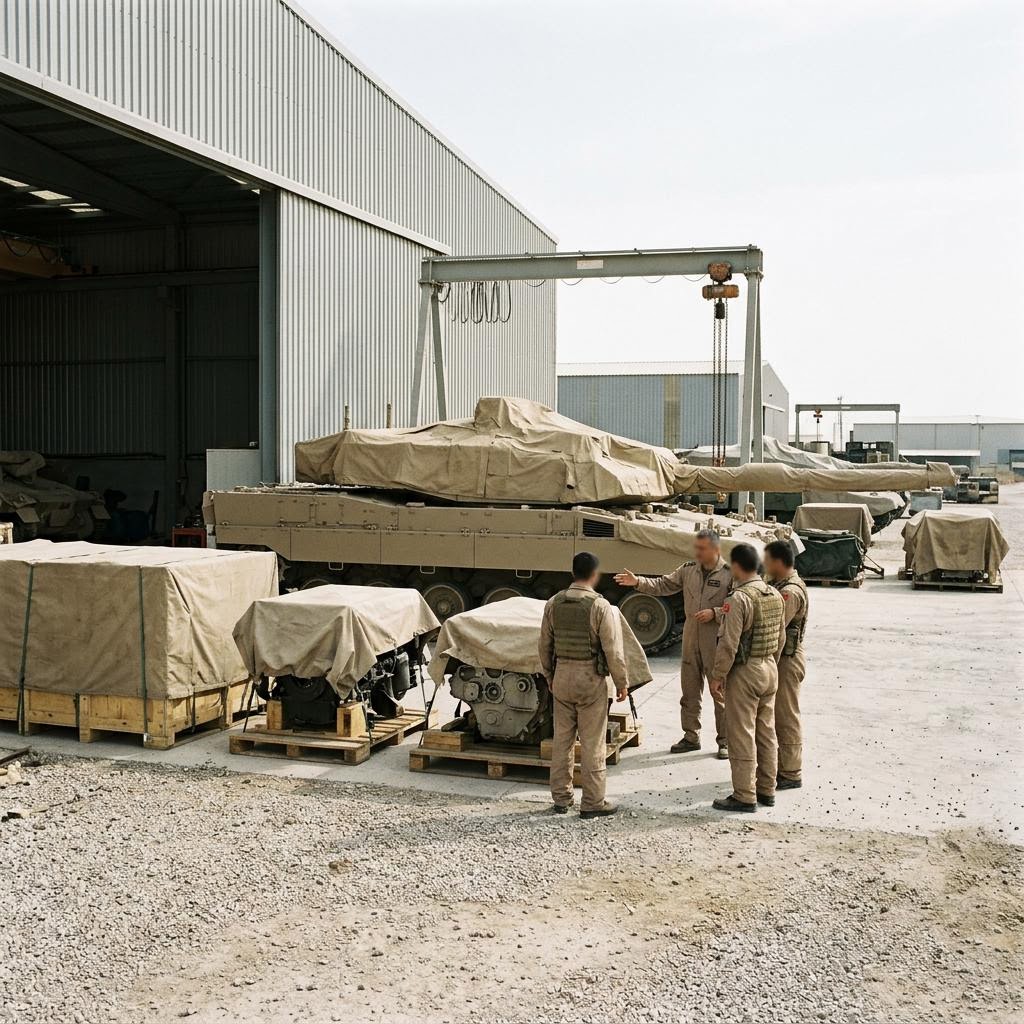
Turkey had a tank design, a contract and prototypes. It did not yet have a secure route to the engine and transmission for serial production.
Defense News reported on 8 March 2021 that Turkish armoured-vehicle maker BMC had reached an agreement with South Korean companies Doosan and S&T Dynamics to supply the engine and transmission mechanism for the Altay main battle tank. The arrangement followed years of delay over access to major components, including the powerpack.
The original plan depended on German equipment. Turkey had hoped to use an MTU engine and RENK transmission, but talks with German manufacturers failed after a federal arms embargo on Turkey restricted export licences. The German decision was part of broader European limits on exports connected to Turkey’s involvement in the Syrian civil war. The result was not the destruction of the Altay design. It was a blocked route from the national programme to an equipped production tank.
The South Korean deal was a workaround, not immediate independence. A BMC official told Defense News that Doosan would supply the engine and S&T Dynamics the transmission. Sources familiar with the programme said South Korean companies would “de-Germanize” some German components in the powerpack to bypass German export restrictions. The article reported that the companies would also assist with integration.
Integration was the next test. Defense News said a test phase would follow and that, if it went well, the Doosan and S&T Dynamics powerpack might power Altay tanks within 18 months. That was a projection in March 2021, not evidence that the tank entered service on that timetable. The report did not establish a final production date, delivered quantity or operational availability.
The South Korean substitute was itself not a frictionless off-the-shelf answer. South Korea had faced comparable K2 Black Panther powerpack problems. Its first 100 tanks used a Doosan 1,500-horsepower engine and an S&T Dynamics automatic transmission. After that transmission failed durability tests, a second batch was to use a hybrid powerpack with a locally developed engine and German RENK transmission. The comparison did not prove that Altay would suffer the same failure. It showed why replacing an engine and transmission requires testing rather than a simple change to a purchase order.
The programme’s history made the delay more consequential. The Altay project dated back to the mid-1990s. Turkey’s government awarded BMC a multibillion-dollar production contract in November 2018 after the company won a competition against Otokar, which had produced four prototypes. The contract covered an initial batch of 250 tanks, life-cycle logistics support and a tank-systems technology centre. It also called for a tank with an unmanned fire-control unit.
AI-generated representative image.