
Turkey bought Russia’s S-400. It lost its F-35 place.
The first S-400 components arrived in July 2019. Washington began removing Turkey from the fighter programme it had helped build.
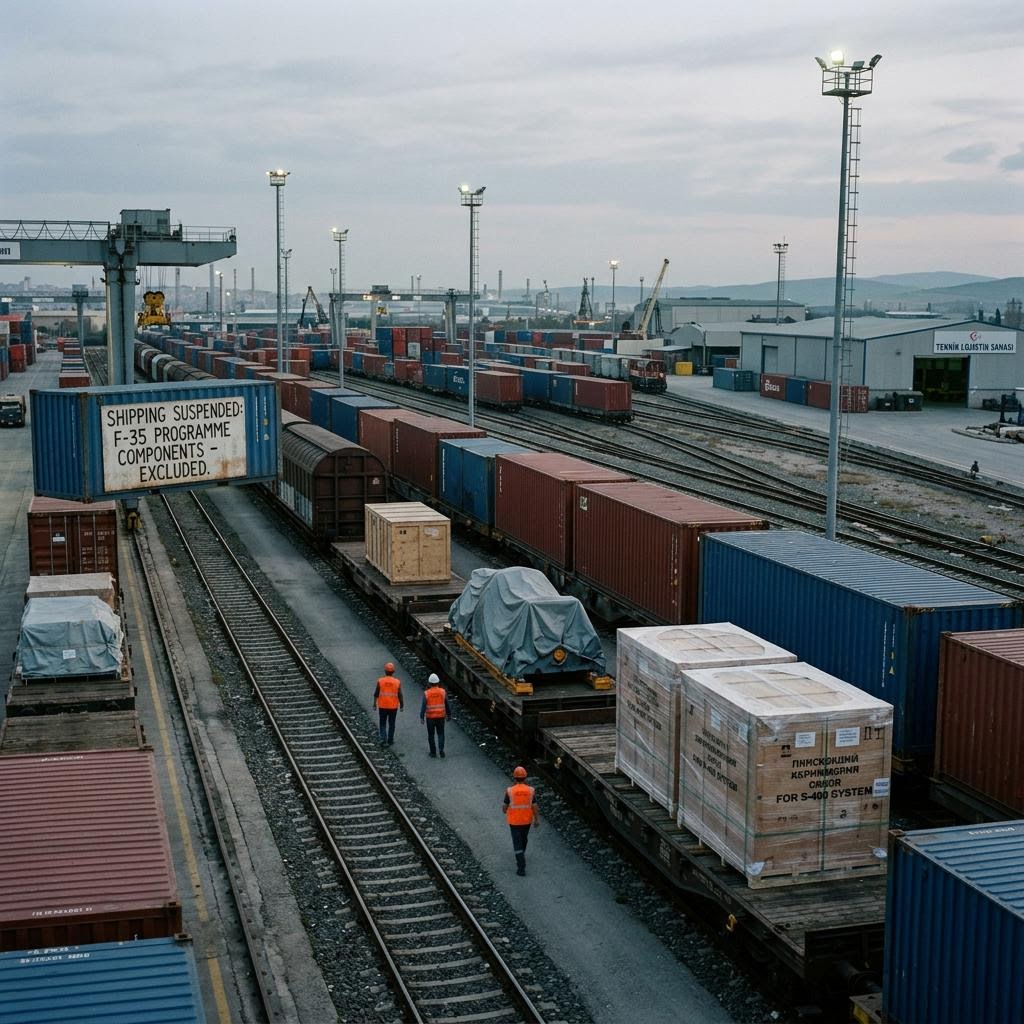
Turkey wanted an advanced fighter and an independent air-defence system. In July 2019, Washington said it could not keep both choices inside the same programme.
The immediate trigger was Turkey’s acceptance of Russia’s S-400 surface-to-air missile system. On 17 July 2019, Pentagon officials said the United States was beginning the process of unwinding Turkey from the F-35 Joint Strike Fighter programme. Undersecretary of Defense for Acquisition and Sustainment Ellen Lord and Deputy Undersecretary of Defense for Policy David Trachtenberg said Turkey had taken delivery of the Russian-built system.
The Pentagon’s position was not that Turkey had merely bought a different product from a different supplier. Officials said the S-400 and F-35 were incompatible. Trachtenberg described the American response as “a specific response to a specific event” and said Washington still valued its strategic relationship with Turkey. Lord said the F-35 and S-400 could not be fielded together because a Russian intelligence-collection platform near F-35 facilities could expose information about the aircraft’s stealth characteristics.
The programme decision had two sides. Turkey was removed as a prospective F-35 customer, and it was also being removed from the international industrial partnership. Turkey had been an original member of the US-led consortium that shared development and production costs. The consequence was therefore wider than a cancelled delivery. It reached into the manufacturing role that Ankara had built around the aircraft.
Lord said the United States and other F-35 partners were aligned in suspending Turkey and beginning formal removal. The Pentagon also said it had tried to offer an alternative path based on the Patriot air-defence system and NATO interoperability. Those statements record the US explanation. Turkey did not accept it. Ankara argued that the decision was unjust and maintained that the S-400 would not be integrated into NATO.
The difference between the positions matters. The United States treated the Russian system as a security risk to the F-35 and to alliance interoperability. Turkey treated the S-400 acquisition as a sovereign air-defence decision and rejected Washington’s assessment.
There was also a difference between announcing removal and completing every legal consequence. The Pentagon described a process that began with suspension and formal unwinding. The Congressional Research Service later recorded that Turkey was removed in July 2019 after procuring the S-400 and that Congress enacted a law in December 2019 prohibiting F-35 transfers to Turkey. That later statutory step made the aircraft-access consequence more durable.
AI-generated representative image.