
Rockets hit Balad. Lockheed moved Iraq’s F-16 team out.
Lockheed Martin said on 10 May 2021 that it was relocating its Iraq-based F-16 team after rocket attacks at Balad air base. The company planned remote support, but the record does not measure any change in aircraft readiness.
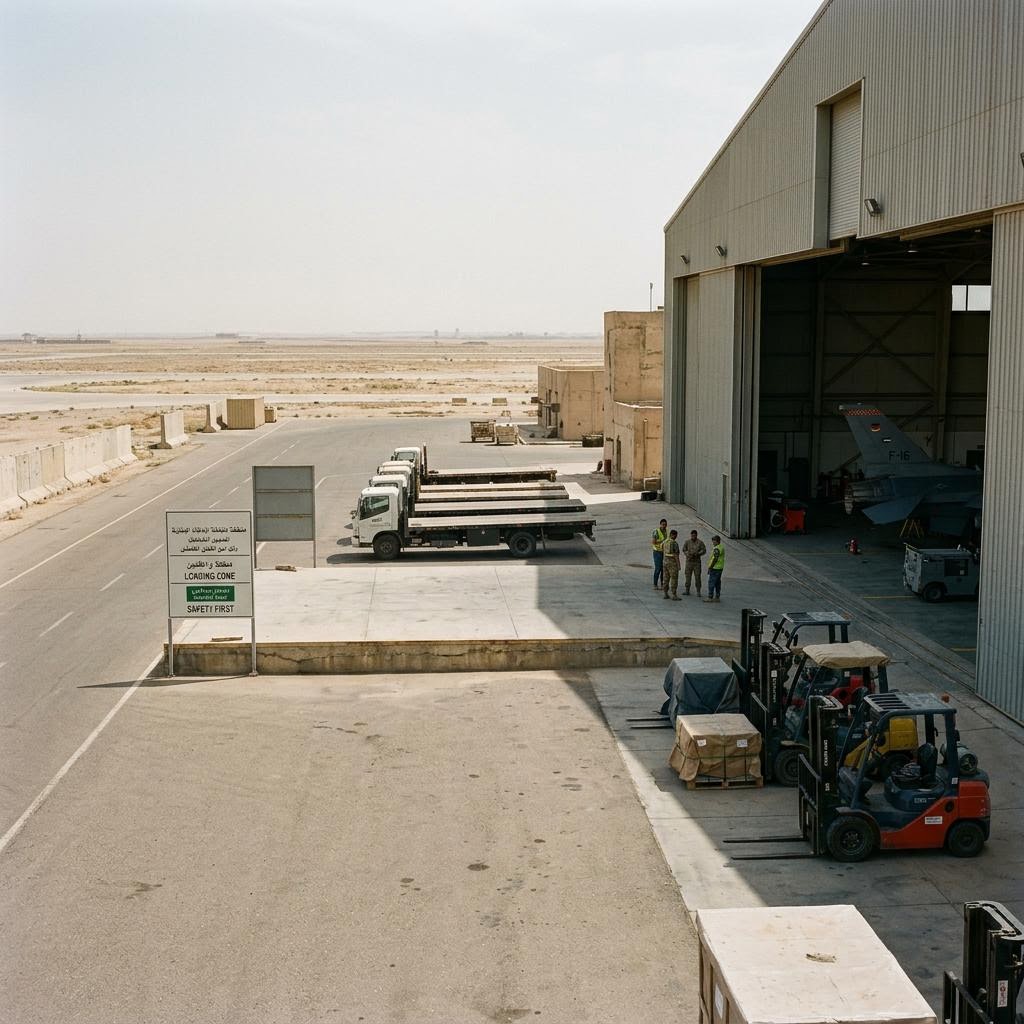
The fighters stayed at Balad. The people responsible for supporting them had to move.
On 10 May 2021, Lockheed Martin told Reuters that it was removing contractors working on Iraqi F-16 maintenance from Balad air base because of security concerns. The base, north of Baghdad, had been hit repeatedly by rockets. Reuters reported that three rockets struck it earlier that month and that later attacks had come close to areas where Lockheed operated.
The company described the move as a safety decision made in coordination with the US government. “In coordination with the U.S. government and with employee safety as our top priority, Lockheed Martin is relocating our Iraq-based F-16 team,” Lockheed said. That is a direct company explanation, not an Iraqi admission that its aircraft had become unusable.
The distinction matters. The event was a relocation of maintenance personnel, not a public order grounding every Iraqi F-16. Reuters said it was not immediately clear how many contractors had been working at the base or where they would be repositioned. A person familiar with the matter said Lockheed was establishing a remote team to provide virtual support to the Iraqi Air Force. Many contractors had already been working remotely for much of 2020, and a handful of US citizens were among those being relocated.
Remote support is not the same thing as a physical maintenance detachment. The article does not specify which tasks could be performed remotely, which required access to an aircraft, or whether Iraqi technicians could take over those tasks. It therefore supports a narrower conclusion: the security environment disrupted the original support arrangement and forced the contractor to change how assistance was delivered.
Balad had been a known risk rather than a newly discovered inconvenience. Reuters said US officials believed Iranian-backed militias carried out the rocket attacks. The report also said the United States had repeatedly called on the Iraqi government to do more to address them. Those are reported US assessments and government positions. They should not be presented as a judicial finding about responsibility for each attack.
The chain from attack to procurement constraint was direct. Lockheed had personnel at a base where the company’s operating areas were being threatened. The company could not treat the safety of those personnel as a secondary consideration to the customer’s maintenance schedule. Once the people moved, Iraq had to rely on a different combination of remote assistance, its own technicians and any later arrangement that is not documented in the cited report.
That does not mean Iraq had no maintenance capability. Nor does it show that the country could perform none of the work. the available reporting describes a dependence on external support for the full maintenance range, but the Reuters report does not quantify that dependence or identify a task that was missed. The article also does not say how many aircraft were at Balad, how many were undergoing maintenance, or whether any were unavailable on 10 May.
AI-generated representative image.