
14 May 2026
A threat with a regional case history
The Gulf did not need the 2026 war to take drones seriously: attacks on regional energy facilities and airports over the preceding years had already demonstrated that inexpensive unmanned aircraft can reach and damage nationally critical sites. The conflict reinforced the lesson at scale: mass and persistence, not sophistication, are what defence architectures must now assume.
Why fixed infrastructure is the hard case
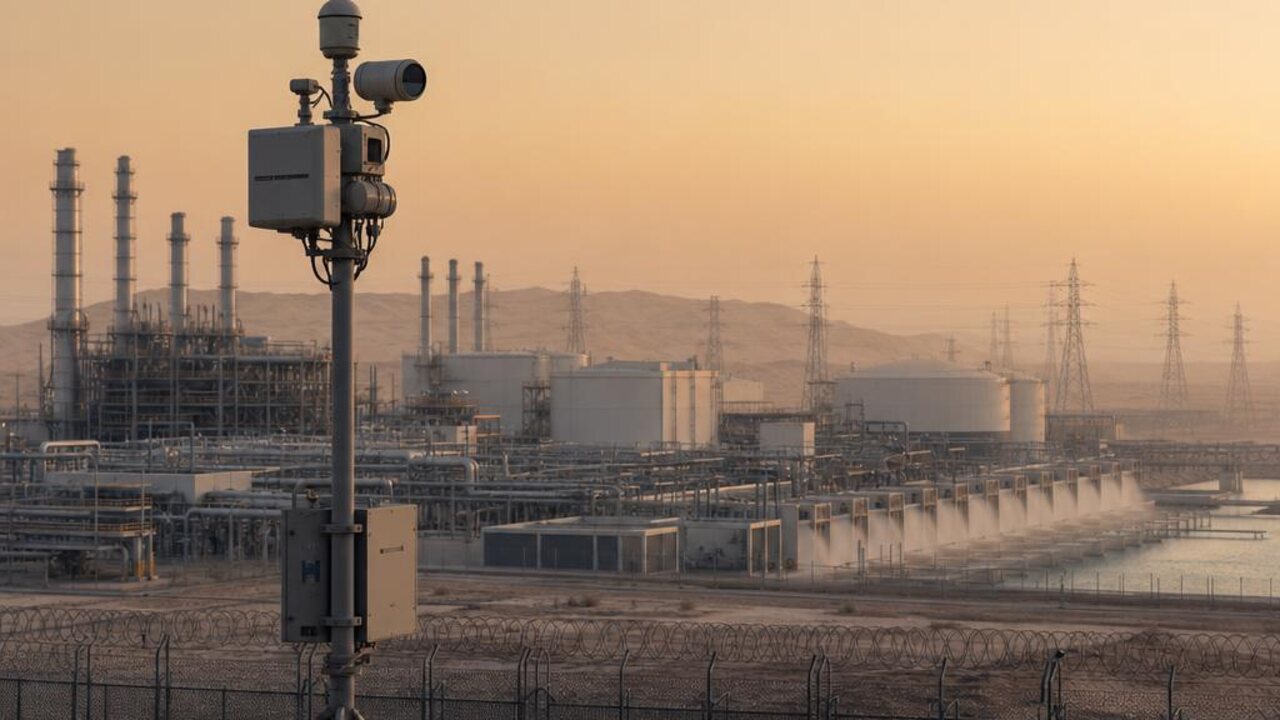
Strategic sites combine every complicating factor: they are large and impossible to hide, surrounded by civilian activity that constrains engagement options, dense with their own RF emissions and, for refineries and gas plants, intolerant of debris and stray effects. The defence must run continuously for years, at facilities where a single leaked success carries national consequence.
The layered architecture
Protection that works is concentric. Persistent wide-area sensing (radar, passive detection, RF monitoring) establishes early warning beyond the perimeter. Classification narrows the picture: hobbyist error, surveillance flight or attack profile. Defeat options are layered from soft to hard (jamming where links exist, interceptors and capture systems where physics must decide), matched to sector-specific collateral constraints. Command-and-control with rehearsed engagement authority binds it together; hesitation is the commonest failure.
Procurement realities for site operators
Gulf operators buying C-UAS should anchor on four realities: the system must be evaluated against the regional threat picture, not a demonstration drone on a calm day; integration with national air defence and civil aviation authorities is a requirement, not an option; spectrum and engagement authorities must be settled before, not after, installation; and the supplier relationship must survive years of operation, upgrades against an evolving threat, and the region's politics, which argues for accountable, non-aligned channels.
What this means for critical-infrastructure operators
Protecting energy, water and transport sites is a continuous mission, not a one-off installation, and the operators who fare best treat it that way. The advantage comes from a concentric architecture that gives early warning well beyond the perimeter, classifies what it sees, and holds graduated defeat options matched to the collateral constraints of a refinery, a desalination plant or an airport. None of that protects the site unless the legal groundwork is settled first: engagement authority, spectrum permissions, and integration with national air defence and civil aviation. Above all, the supplier relationship has to outlast the region's politics and the threat's evolution, which is why an accountable, non-aligned single channel, able to upgrade the system for years without leaving the operator exposed to shifting alignments, is part of the protection itself.
